CEO Perspective: Child poverty is a choice - and we must choose action
This past week saw the publication of Bringing Hope, Brighter Futures - the Scottish Government’s latest roadmap on its journey to eradicating child poverty. It marks an important moment in Scotland’s continued effort to tackle one of the greatest challenges we face as a society.
Separate from any debate about the pace of progress, it is important to recognise that this country’s government repeatedly names eradicating child poverty as its number one priority. Achieving that level of national political focus has been hard-earned by many campaigners, communities and organisations over many years. The announcements just made to Parliament reflect both the urgency of the challenge and the shared responsibility we all have to create lasting change. Quite simply, too many of our young people deserve better.
At Young Scot, we welcome this renewed focus and are proud to have played a role in supporting young people to directly input their lived experiences and ideas into the policy-making process. We know that young people themselves are often the most effective drivers of social change - particularly those who grow up facing poverty and its impacts, and those of us who have lived experience of struggling.
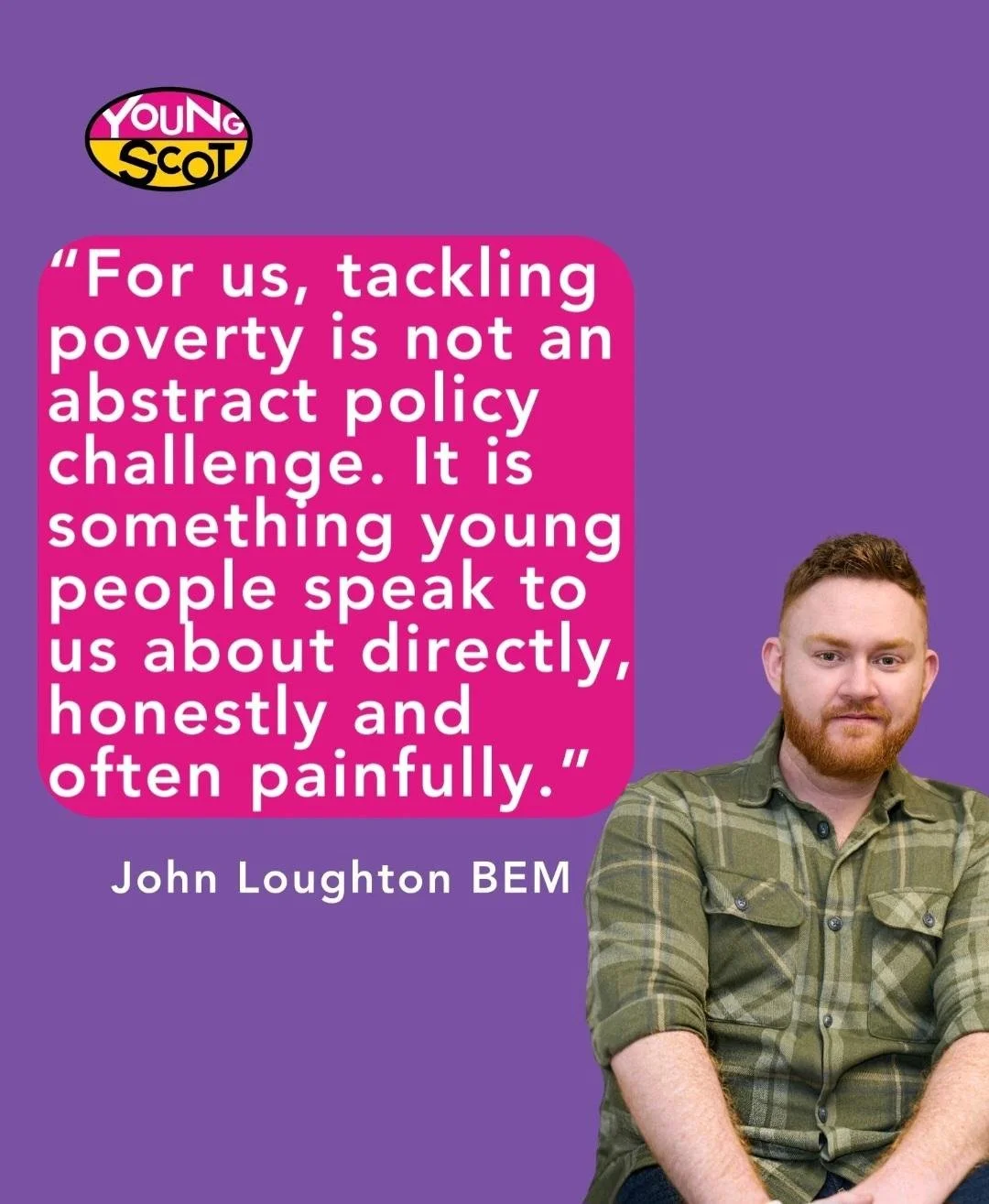
Young Scot is fiercely politically neutral and non-partisan, but we remain committed to strengthening children’s rights and ensuring young people are equal stakeholders in Scotland and beyond. For us, tackling poverty is not an abstract policy challenge. It is something young people speak to us about directly, honestly and often painfully.
One young person told us:
“It’s not normal to go weeks without a proper wash because hot water is too expensive… to do nothing outside of school because sports cost money.”
Young people experiencing poverty understand its realities better than anyone. Their experiences highlight the everyday barriers that statistics alone cannot capture: the strain on family life, the impact on confidence and wellbeing, social exclusion, and the inevitable quashing of opportunity or sense of hope.
This is something I understand personally. Growing up, my own childhood was shaped by financial struggle, unstable family circumstances, dangerous housing and the trauma that accompanies poverty. The future often felt uncertain and opportunities felt distant. Hope wasn’t for people like me. We often lived down to the expectations kids in schemes like ours were given.
What changed the trajectory of my life, was well-placed and caring people who believed in my potential. The youth workers that created space for us to raise our voices. The community buildings that gave us safe space to roam. The voluntary sector organisations that helped us cross the rivers in life where there were no bridges. Their investment meant we no longer faced a poverty of aspiration.
Those experiences have shaped my belief that when young people are trusted, supported and listened to, they can positively shape the systems that too often negatively shaped them.
Children’s rights lens, whole family approach
Scotland has made important progress by recognising that reducing poverty is also about protecting and advancing children’s rights. Proactively observing how our systems and policies impact children and young people, is a gamechanger in getting it right for every child. That is why tackling child poverty must be grounded in listening to young people and their families - and acting on what they tell us.
When I raised the importance of youth voice and lived experience in shaping policy with First Minister John Swinney this past week, he said:
“Young Scot help Scotland and the Scottish Government enormously on this issue (child poverty) and we are committed to ensuring young people's experiences and voices are at the heart of this work moving forward, including the Child Poverty Delivery Plan.”
This commitment matters. Policies designed with young people, rather than simply for them, are far more likely to address the realities families face every day.
Through Young Scot’s engagement work, young people speak openly about the pressures poverty places on their lives; the stress linked to family finances and the stigma they feel when they cannot participate in the same activities as their peers.
Our recent survey showed that 98% of young people recognise the benefits of hobbies, yet almost half (48%) say cost is the main barrier to participation.
They also crucially tell us that solutions must take a whole-family approach.
One young person shared:
“When a family is in a better financial situation, it means children… can focus more on what they want to do without financial stress.”
Another described the toll financial hardship takes on parents and carers:
“I am very concerned about my mum’s mental health and physical health especially as she owes so many bills... and there's nothing she can do apart from paying it in small chunks monthly. It's upsetting because she can't afford to treat herself or use the money wisely.”
These voices remind us that tackling child poverty cannot focus on children in isolation. It must support their families and wider support structures.
Turning insight into action
Young Scot's impact, alongside our partners, already helps the national efforts in realising the key drivers that can reduce poverty:
Income maximisation:
Unlocking youth skills, citizenship and personal social development is at the heart of the national prevention agenda. Organisations doing this should be viewed as critical public infrastructure. Access to the right relationships and services can make a real difference in helping realise a vibrant and skilled young workforce. Work carried out just a couple of months ago by Young Scot highlighted for example how inadequate and work experience opportunities are.
Benefits and social security:
Young people and families often tell us that navigating support systems can feel confusing or overwhelming. Providing clear, trusted information helps ensure people can access the help available to them – particularly with such a recently changed and changing Scottish social security landscape.
Reducing the cost of living and financial barriers:
Many of the challenges young people describe relate directly to the everyday costs of participation - travel, activities, learning and social life.
Through the Young Scot National Entitlement Card and the wider Young Scot offer, these pressures are reduced. This includes supporting the delivery of Free Bus Travel for Under 22s. This flagship move enables young people to attend college, work, appointments or engage in youth work and sport. Young people and their families can also maximise their income through our universal discounts, as well as access to free legal proof of age.
We also deliver the Young Carers Grant and a wider Young Carers Package with YS Rewards, increasing financial security for prioritised groups. Thanks to our technology and shared infrastructure, we can do so in a way that is targeted but crucially stigma-free. Support should never make a young person feel singled out, it should empower them to access opportunities with confidence.
Our previous YSAttain work with Local Authorities has also allowed us to test and demonstrate innovative approaches to improve health and wellbeing outcomes and contribute to tackling the poverty-related attainment gap.
Choosing action for Hope:
The challenge of child poverty is significant, but it is not insurmountable.
Scotland has shown leadership in recognising that solutions must combine policy action with the lived experiences of those affected. We are making progress, but we must go further. Listening must remain central to how we design and deliver solutions. Because when young people are genuinely heard, they do more than describe the problem — they help lead the change.
At Young Scot, we will continue working with young people, partners and government to ensure their voices remain at the heart of Scotland’s efforts to eradicate child poverty.
Poverty is not inevitable. Young people give me hope, and keeping their rights centre stage is what will help realise brighter futures.
John Loughton,
CEO Young Scot.